


ROOSC Project Mobilizes Community Leaders to Ensure Education for Out-of-School Children
By: Femi Mustapha
The Reaching Out-of-School Children (ROOSC) Project, in partnership with Save the Children and UNICEF, recently engaged members of the Community Coalition in a two-day training aimed at identifying and mobilizing out-of-school children for enrollment in schools.
The training was held at LGEA Model Primary School in Kaduna North and saw participation from a diverse group of community members, including women, youths, persons with disabilities, traditional leaders, and religious representatives.
Key subject areas covered during the training included: Understanding the Community Coalition, the roles and responsibilities of Community Coalition Members, the Community Action Cycle, Resource Mobilization, and the Importance of Record Keeping.
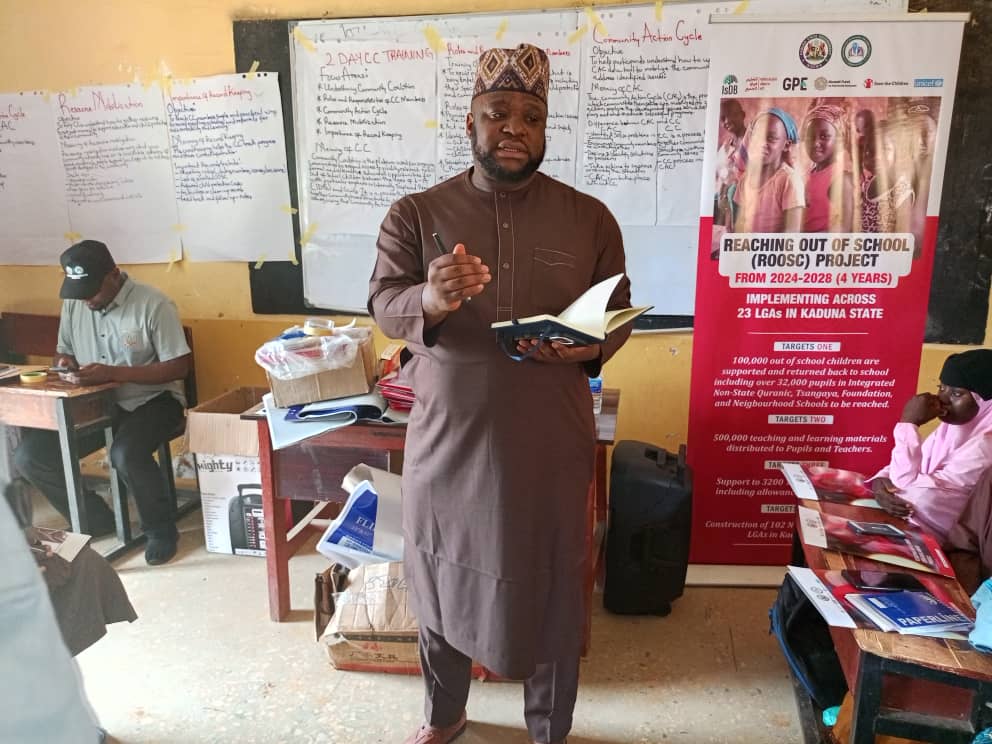
While addressing the participants, ROOSC Project Coordinator Mr. Ezra Angai explained that the Community Coalition serves as a platform for engaging communities to expand access to quality and relevant non-formal and alternative education opportunities for out-of-school children aged 6 to 17, with a particular focus on Internally Displaced Persons (IDPs) and girls.
Mr. Ezra emphasized that the training’s objective was to ensure participants understand what a Community Coalition is and how it can promote community development, especially in the areas of education, child protection, and health.
“The ROOSC Project represents a holistic approach by the state government to reach out-of-school children,” he said. “Some of the challenges we face include access to quality education, creating a safe learning environment for learners, ensuring the quality of teaching and learning, and strengthening the educational system.”
He stressed the necessity of involving communities, as they are the first responders when it comes to education. Hence, the importance of the two-day training for community members cannot be overstated.
“There is a significant need to engage communities,” he continued. “This training is designed for members of the Community Coalition, which comprises community and traditional leaders, influential individuals, and other stakeholders such as women and youths. Together, they form a strong coalition that ensures that interventions brought to the communities are sustained and receive the attention they deserve.”
Mr. Ezra also shared that a framework has been developed and distributed to coalition members on how to effectively carry out their functions and responsibilities. “There is a seven-step model they will interact with, which is included in the training materials. Each participant will receive this information to help them effectively promote community-based support for education.”
The project was launched last year, and preliminary steps included identifying and establishing community centers, conducting advocacy, and mapping local government areas to identify regions with out-of-school children to establish a solid baseline for their work. The enrollment process began last month and is ongoing, with a target of enrolling 10,000 children within the year.
Kabir Lawal, the Director of the Social Mobilization Department at the State Universal Education Board (SUBEB), noted that the participants would be trained as advocates for child rights and protection, encouraging them to return to their communities to identify and reintegrate out-of-school children.
“The Governor of Kaduna State, Sen. Uba Sani, wants to ensure that no child is left out of school,” he stated. “Participants should go back to their communities, raise awareness among others, and work collaboratively to achieve this goal.”
He urged the trainees to pay close attention to their trainers, contribute constructively, and commit to doing their utmost to identify and reintegrate out-of-school children upon their return to their communities.
One of the participants, Rev. Zakari Ogar, the CAN Chairman of Malali, expressed that the initiative is a step in the right direction and timely, especially considering the high number of children out of school in the state.
He remarked on the program’s comprehensive coverage across all 23 LGAs in the state, highlighting its potential to reach rural areas and offer underprivileged children an opportunity for quality education. “This initiative aligns with our long-standing vision for education. We desire inclusiveness in training and educating our children, as a society lacking education is doomed to fail. This organization has come at the right time to address this critical need.”


