

SPHCB, UNICEF Hold Stakeholders’ Meeting to Pave Way for Scaling Up MMS in Kaduna
By: Femi Mustapha
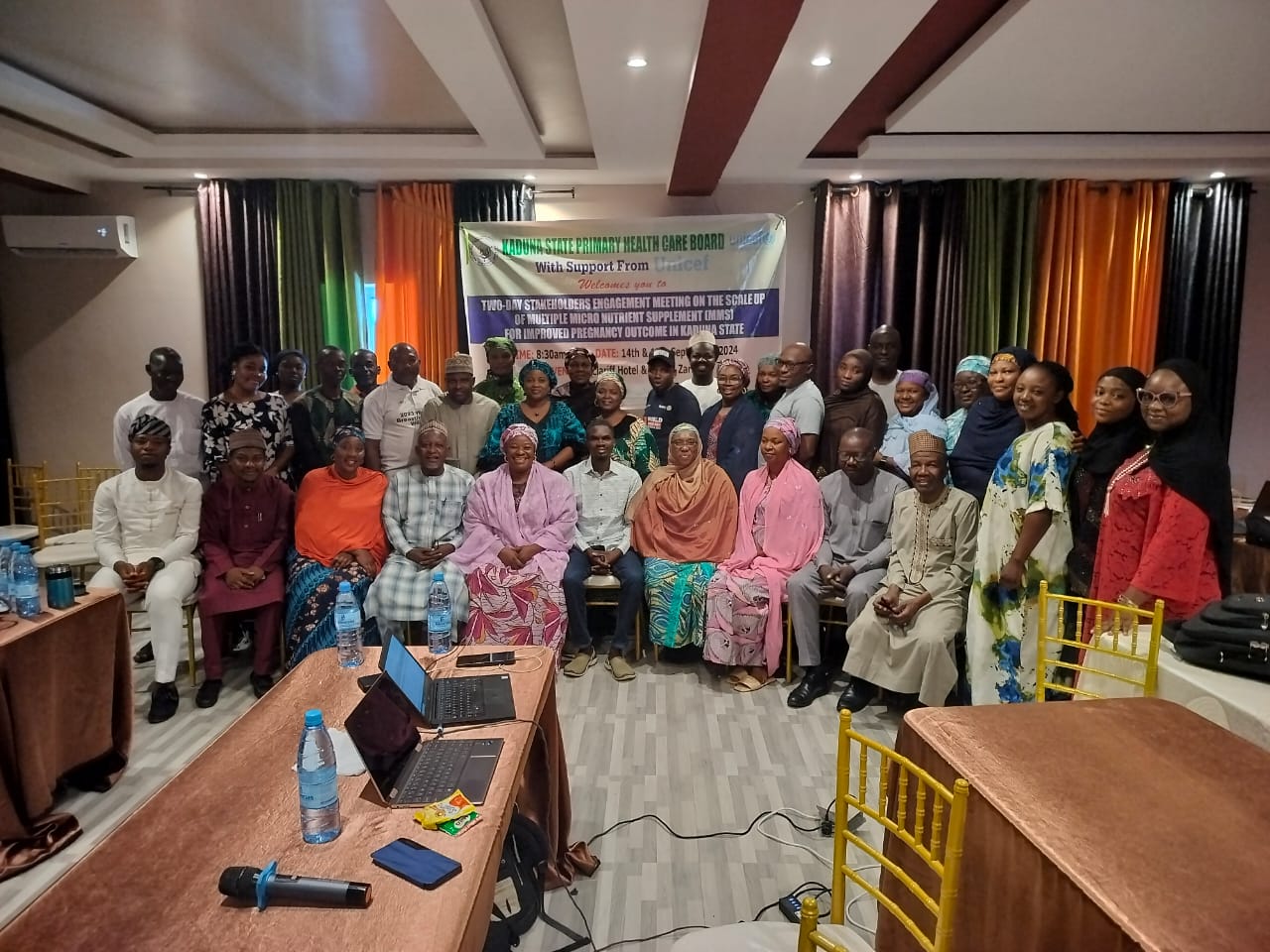
The Kaduna State Primary Health Care Board (SPHCB), in collaboration with UNICEF, has organized a two-day stakeholders’ meeting on the Scale-Up of Multiple Micronutrient Supplements (MMS) in Zaria today.
Declaring the meeting open, State Commissioner of Health, Umma Kaltume Ahmed, urged the stakeholders to scale up Multiple Micronutrient Supplements (MMS) to reduce the negative effects anemia has on pregnant women.
The Commissioner, who was represented by the Permanent Secretary in the Ministry, Dr. Aisha Abubakar, said the government and the stakeholders are targeting every pregnant woman and child because every woman who is pregnant needs MMS.
According to her, Kaduna State has a 76.1% prevalence of anemia in women and children under 5. Among pregnant women, more than 56.1% have anemia; for men, it’s 22.1%, and for young girls, it is above 40%.
She opined that the data shows a disproportionate value. Men who earn income have access to what they want to eat, but women, who have to eat based on what is cooked in the house, have the worst values.
“It indicates that there are gaps, and our mission is to bring it down to zero if possible and to change the negative behavior, encouraging positive practices for their good health,” she said.
The Commissioner disclosed that the MMS functions like an administration. Differently, a dose is like magic; it gives all the needed nutrients to develop and strengthen the immune system and care for general health and even skin.
“We are hoping to get the supplement as soon as possible; the stakeholders’ engagement is to get everybody on board. We have representatives from various ministries like Agriculture, Health, and the rest. We have CSOs and planning officers.
“We are trying to access funds from the government to make sure we procure as much as possible.
“The federal government has made available enough funds to secure as much as possible to distribute to the pregnant women.
“For now, we already have a stock of MMS, and this first phase will last till 2025, so it’s just to get everybody on board.
“The stakeholders will draw a work plan for distribution, community engagement, advocacy, transportation, supply, and health education in the 23 LGAs across the state,” she said.
“Our government, under the leadership of Senator Uba Sani, is committed to procuring more, storing more, and distributing more for us to use within our system.”
In her welcome remarks, the Director of Family and Community Health Services in the State Primary Health Care Board (SPHCB), Hajiya Nafisat Musa Isah, stressed that empirical evidence from clinical trials over the last two decades has consistently shown that MMS offers additional benefits over Iron and Folic Acid Supplements (IFAS) in reducing adverse pregnancy outcomes that negatively impact the first 1,000 days of life and beyond.
She added that multiple micronutrient supplementation enhances pregnancy outcomes by significantly reducing low birth weight. Pre-pregnancy micronutrient supplementation should be taken by women of childbearing age to enhance childbirth weight.
She, therefore, called on all stakeholders to work as a team in the move to get the MMS to the citizens in the state.
The State Nutrition Officer, who is also the Program Manager of the MMS project in the state, Mrs. Ramatu Haruna, explained that the objectives of the stakeholders’ meeting are to educate stakeholders on MMS and its importance, foster partnership and collaboration among stakeholders to ensure a coordinated and effective approach to scaling up MMS, and secure commitment from stakeholders and agree on an actionable roadmap with a clear timeline, roles, and responsibilities for the Scale-Up of MMS.
The UNICEF Nutrition Officer, Kaduna Field Office of UNICEF, Yadika Charles, said antenatal Multiple Micronutrient Supplementation (MMS) for pregnant women has been proven to improve maternal nutrition status.
He revealed that the MMS intervention campaign is being sponsored by the Bill and Melinda Gates Foundation, adding that only five states in Nigeria, including Kaduna, are currently benefiting from the project.

The nutrition specialist also urged stakeholders to create an enabling environment for MMS acceptability and intervention to prevent anemia among pregnant women.
According to him, the partnership between UNICEF, the Bill and Melinda Gates Foundation, Alive and Thrive, and CS-SUN is to improve pregnancy outcomes.
The nutrition specialist, who described MMS as a blessing, appreciated the state government for approving N100,000,000 as its counter-funding.
He emphasized that MMS is safe, efficacious, affordable, and cost-effective, and is one of the interventions to improve maternal nutrition and serves as a preventive intervention that should be provided to pregnant women.
In her presentation, the Project Manager of Accelerating Nutrition Results in Nigeria (ANRiN), Dr. Zainab Idris Kwaru, said pregnancy increases the daily requirement of several vitamins and minerals to meet the nutritional needs of the developing fetus and other metabolic functions.
Antenatal MMS, according to her, is designed to address these heightened demands, which are often not met through diet alone. It is particularly useful for pregnant women in resource-poor settings where micronutrient intake is typically low due to poor dietary diversity, limited access to nutritious food, gender inequity, and prevalent social norms.
Dr. Zainab disclosed that the United Nations International Multiple Micronutrient Antenatal Preparation (UNIMMAP) MMS is an internationally accepted and standardized formulation that contains 15 essential vitamins and minerals, including iron and folic acid, in recommended doses. In 2021, UNIMMAP MMS was included in the World List of Essential Medicines, and the federal government has since followed suit.
She explained that, in comparison with iron and folic acid supplements (IFAS), MMS further reduces the risk of adverse birth outcomes such as preterm birth, stillbirth, low birth weight, and small-for-gestational-age birth.
Scaling up programs that deliver MMS to vulnerable mothers is now an urgent priority. This requires efficient supply chain systems and building awareness of its health benefits among mothers, communities, and maternal healthcare providers.


