


Poverty Eradication: IPA supports Kaduna govt to design Ultra poor Graduation program
By: Femi Mustapha
Worried by the high rate of poverty bedeviling the rural women in Kaduna State, the Innovation for Poverty Action(IPA) is supporting the State Government to design an ultra-graduation program that will be human-centric and underlying self-confidence, power, and capabilities in the women.
A Graduation Consultant with Innovation for IPA, Mr. Victor Ogharanduku, asserted this during a 2-Day Graduation Programme Pre Design workshop for the Kaduna State Graduation Programme for Rural Women held in Kaduna today.
Speaking on the workshop With the theme: Designing an Inclusive and Sustainable Graduation Program for Women in Rural Communities the consultant said that government at all levels must develop and implement policies geared to more equitable distribution of wealth income and Social protection coverage to eradicate poverty in the country.
According to him, research from the social perspective on development requires addressing poverty in all its dimensions, saying it must promote a people-centered approach to poverty eradication.
He advocated for the empowerment of people living in poverty through their full participation in all aspects of political, economic, and social life, especially in the design and implementation of policies that affect the poorest.
Speaking on the Graduation Approaches, he explained that it is a human-centric investment in the underlying self-confidence, power, and capabilities of participants.
He added that It is intended
for individuals in households who live under extremely difficult circumstances, but who nevertheless possess untapped potential to be agents of
their pathway out of poverty.
“It is a sequenced, time-bound, adaptive investment that addresses multiple constraints through a big push,
enabling participating households to build a long-term trajectory of increasing self-confidence, social power, and economic gains.
“The Graduation approach goes by many different names in varying contexts. We support terms that are contextual and localized. What is most
important is that the underlying Essentials are in place – not what label is used. Likewise, not all things labeled “Graduation” actually meet the”
Mr.Ogharanduku observed that the Graduation Arc depicts the poverty graduation model as a sequence of consumption support, skills enhancement, asset transfer, saving, and microfinance, with “graduation” into sustainable livelihoods as the end goal.
“Different interventions are tailored to each poverty band to ensure that the correct mix of tools is used to effectively graduate beneficiaries to a higher score on the poverty scorecard.
“The beneficiaries with a score between 0 to 37 are eligible for a combination of asset transfers and training. This includes social safety nets, cash transfers, and other social protection programs.
“The beneficiaries scoring between 0-50 are offered interest-free and concessional loans as well access to microfinance plus schemes. The beneficiaries scoring above the poverty score of 50 are offered regular microfinance and SME Finance business support”.
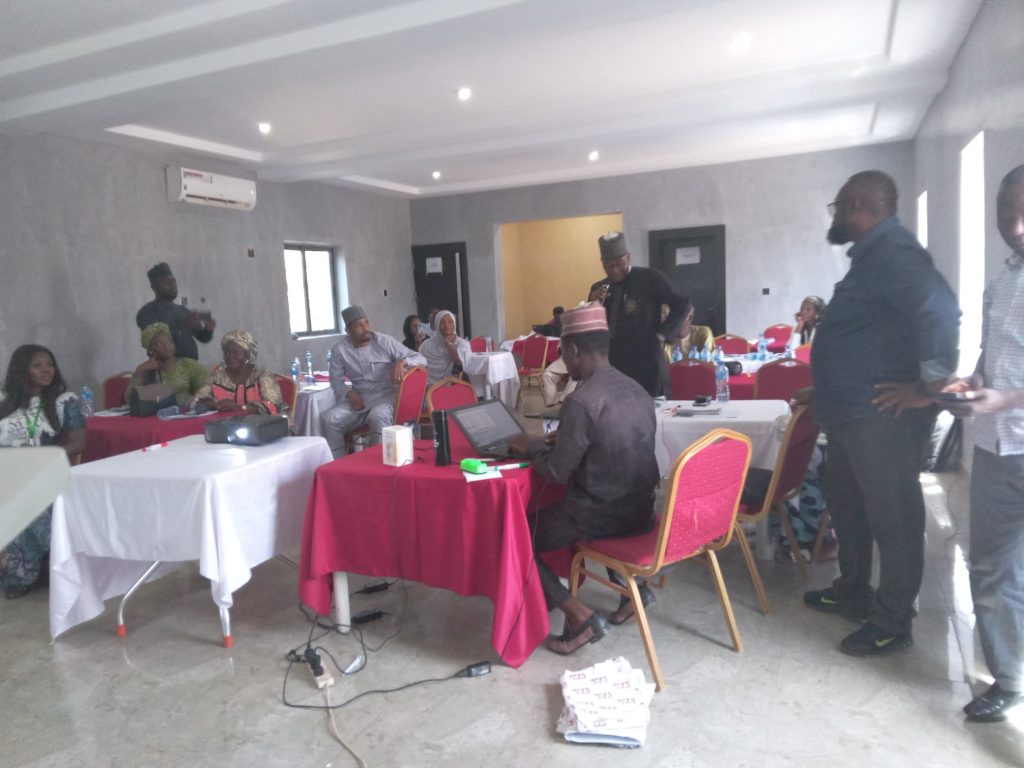
In her Keynote address, the Special Adviser on Social Investment Programme to Kaduna State Governor Senator Uba Sani, Bridget Sulaiman Esq, Said the workshop marks a significant milestone in the State’s collective commitment to poverty eradication, women’s empowerment and inclusive economic development.
She expressed her gratitude to the State Governor for his unwavering dedication to social protection and financial inclusion.
According to her his vision, encapsulated in the SUSTAIN agenda, has provided a solid foundation for innovative programs that prioritize the most vulnerable in our society.
Bridget Sulaiman surmised that in 2024, the Governor announced three pilot programs for design, one of which is the ultra-poor graduation program for women in rural areas.
“As we all know, poverty has a face, and too often, that face belongs to a rural woman. In Kaduna State, over 60% of rural women live below the poverty line, facing multiple layers of economic and social exclusion.
“They are often trapped in a cycle of low income, limited access to financial services, and minimal opportunities for economic advancement.
“The Ultra-Poor Graduation Program we are designing today seeks to break that cycle. It is not just about providing temporary relief but building resilience and long-term economic independence for women through a structured, data-driven approach.
“This workshop is only the beginning. We must recognize that no single entity—government, development partners, or civil society—can do this alone. Collaboration is key.
“The Kaduna State Government remains committed to providing the necessary policy support, facilitating partnerships, and ensuring that our social protection systems are data-driven, transparent, and impactful.
“I would like to encourage our partners and stakeholders in this room, I urge you to bring your insights, expertise, and commitment to the table over the next two days.
“Let us seize this opportunity to co-create a program that will change lives, uplift communities, and set a new standard for social investment in Kaduna State.
“I also extend my gratitude to Innovations for Poverty Action (IPA) for partnering with us on this transformative initiative. IPA’s global expertise in evidence-based poverty alleviation strategies gives us a unique opportunity to design a program that is not just impactful but also scalable and sustainable.” She added
The Innovations for Poverty Action (IPA) is an American non-profit research and policy organization founded in 2002 by economist Dean Karlan.IPA worked with over 400 leading academics to conduct over 900 evaluations in 52 countries.
The organization also manages the Poverty Probability Index.IPA conducts randomized controlled trials (RCTs), along with other types of quantitative research, to measure the impacts of development programs in sectors including microfinance, education, health, peace and recovery, governance, agriculture, social protection, and small and medium enterprises.
Its partner organizations include over 400 governments, nonprofits, academic institutions, foundations, and companies.IPA has 19 country offices and our theory of change addresses two problems we see in the world:
Limited evidence exists on what works to help people living in poverty, and the evidence that does exist often goes unused.
“This leads to programs that are either ineffective or not as effective as they could be, and often to wasted money and enduring poverty.
“IPA exists to solve these problems. We test promising ideas across contexts and along the path to scale, proactively engage key decision-makers throughout the research process, share findings with the right people at the right time, and equip partners with the skills and tools they need to use data and evidence. “


