

From: Femi Mustapha in Kaduna
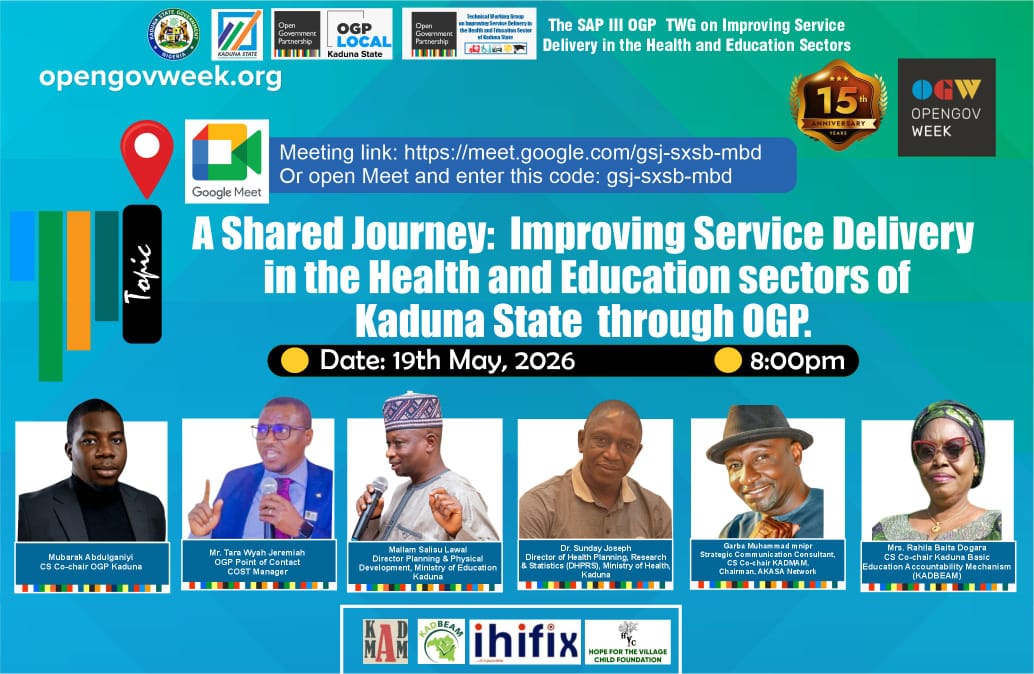
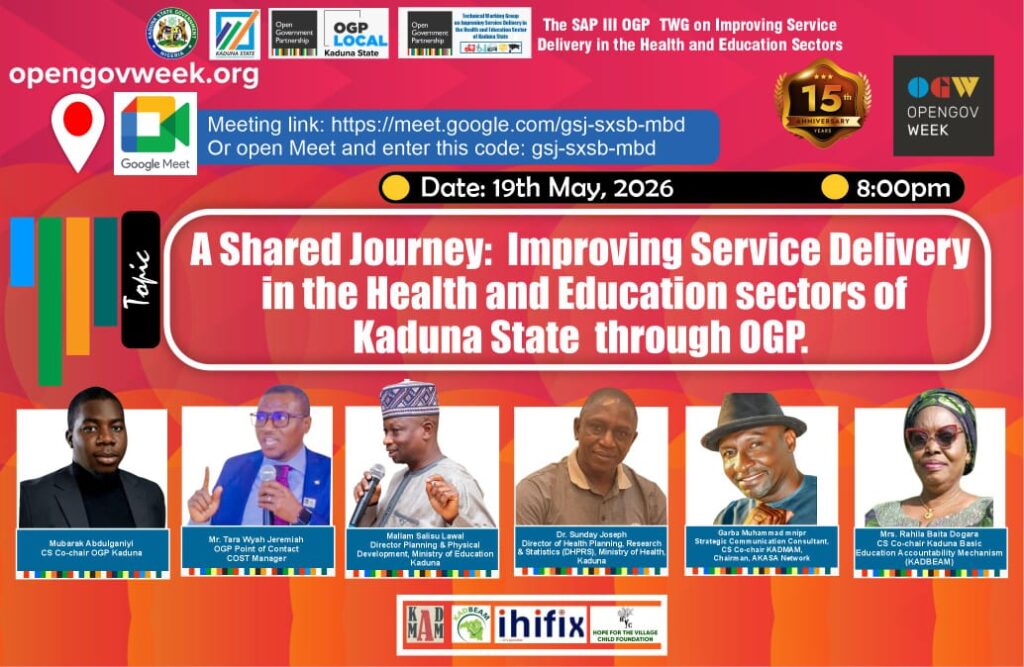
Kaduna State’s Technical Working Group on Improving Service Delivery in the Health and Education Sectors hosted a virtual meeting on May 19, 2026, as part of the global Open Government Partnership (OGP) Week, to review progress and plan next steps to strengthen public service delivery.
Held under the theme “A Shared Journey: Improving Service Delivery in the Health and Education Sectors of Kaduna through the Open Government Partnership,” the event marked Kaduna’s participation in the 2026 OGP Week, which ran from May 18 to May 22 and celebrated 15 years of the global initiative.
While 90 participants registered, over 50 attended the session, which brought together government officials, civil society leaders, traditional and religious leaders, the media, and development partners. Key attendees included SAP III OGP Civil Society Co-chair Mallam Mubarak Abdulganiyi, OGP Contact/Coordination Manager Tara Jeremiah, Director of Planning and Physical Development at the Ministry of Education Mallam Salisu Lawal, and Director of Health Planning, Research, and Statistics Dr. Sunday Joseph.
In his opening remarks, Mallam Abdulganiyi outlined the successes of State Action Plan III and explained efforts to institutionalize OGP at the local government level. He revealed that Kaduna South LGA had joined the partnership, with plans underway to onboard the remaining 22 LGAs.
He noted that Kaduna operationalizes OGP through open forums, the Community Development Charter, participatory budgeting, citizens’ feedback portals, open procurement systems, and permanent dialogue platforms between government and citizens.
OGP Contact/Coordination Manager Tara Jeremiah traced Kaduna’s journey from SAP I to SAP III since joining OGP in 2018 as one of Nigeria’s pioneering subnational governments.
He said the framework had strengthened open budgeting, fiscal transparency, citizen participation, open contracting, and service delivery in health, education, and social protection.
Participants reviewed the evolution of the relationship between government and civil society. Speakers noted that before Kaduna joined OGP, interactions were marked by distrust,
limited access to budget and contract information, and adversarial advocacy. CSOs often relied on speculation and operated mainly as external watchdogs due to the absence of institutional dialogue platforms.
Since joining OGP, that dynamic has shifted toward collaboration. Government officials and civil society actors now work together within formal OGP structures to review reforms, budgets, procurement processes, and service delivery outcomes. The partnership has fostered mutual trust, co-creation of state action plans, and structured civic participation through steering committees and data-sharing platforms like CitiFeed.
The meeting also highlighted lessons and gaps. Strong political will, mutual partnership, and digital governance tools were identified as critical to sustaining OGP reforms and improving fiscal transparency. However, gaps remain in public awareness of OGP principles, institutional capacity in some MDAs, funding constraints for civil society tracking initiatives, and inconsistent political commitment at different government levels.
Sector-specific achievements were shared. In health and education, OGP reforms have improved service delivery monitoring, expanded the State Social Register, and increased citizen tracking of the Basic Health Care Provision Fund. Digital feedback platforms now allow residents to report service delivery issues directly to authorities. At the same time, participatory budgeting through the Community Development Charter enables citizens to prioritize health, education, and infrastructure projects.
Kaduna Maternal Accountability Mechanism (KADMAM) and Kaduna Basic Education Accountability Mechanism (KADBEAM) reported tangible results. KADMAM’s advocacy supported an increase in health budget allocation from 9% in 2014 to 15% in 2016, the recruitment of 1,800 skilled health workers, and the upgrading of 255 primary health care facilities. KADBEAM conducted independent school monitoring, generated school performance scorecards, and advocated for higher education budgetary allocations aligned with global benchmarks.
The forum concluded with recommendations to strengthen institutional coordination across MDAs, establish regular OGP media chats, deepen community feedback mechanisms, and improve the digital presence of government platforms. Participants also called for sustained advocacy for the timely release of health and education funds and greater sensitization on OGP principles across the state.
A one-day targeted meeting with health and education stakeholders was proposed as the next step to synthesize priority issues for urgent advocacy to the Kaduna State Government.


