


From: Femi Mustapha
Nigeria is struggling with a twin crisis of insecurity and economic hardship that tests public confidence and government capacity.
Across the North-West, North-Central, and parts of the South, banditry, kidnapping, and communal conflicts have displaced communities, disrupted farming and trade, and overburdened security forces.
Meanwhile, inflation, currency pressures, and failing infrastructure continue to erode living standards, while budget deficits limit funds for roads, hospitals, schools, and jobs.
Experts say the crisis is being worsened by a quieter but equally harmful issue: illicit financial flows, or IFFs. Nigeria loses an estimated $15 billion to $18 billion annually to IFFs, a drain that weakens public finances and fuels insecurity.
Although violent crime gets most of the headlines, anti-corruption and economic specialists argue that untracked money leaving the country undermines the government’s ability to finance security efforts, provide services, and address development gaps.
According to SecFin Africa representative Prof. Abdullahi Shehu, IFFs are cross-border movements of money that are illegally earned, transferred, or used, in violation of national or international laws.
The World Bank describes them as funds linked to corruption, smuggling, drug trafficking, tax evasion, trade misinvoicing, and terrorist financing. Money laundering is just one part of the bigger picture. Laundering makes illegal money look legitimate, often through banks, businesses, or assets. IFFs are more widespread.
A company that underreports crude oil exports to pay less tax commits an IFF, even without laundering. A public official moving stolen funds directly abroad is also an IFF, while hiding them through shell companies is considered laundering.
” IFFs are more widespread. Afterward, underreporting crude oil exports to pay less tax counts as an IFF, even without laundering. A public official transferring stolen funds directly abroad is also an IFF, whereas disguising them through shell companies constitutes laundering.
” One common method is trade misinvoicing. Investigations by the Nigeria Extractive Industries Transparency Initiative (NEITI) and civil society groups have repeatedly found gaps between the crude oil volumes Nigeria reports as exported and what importing countries record as received.
The difference, often totaling hundreds of millions of dollars, never reaches the treasury. Economists spot it by comparing partner-country trade data, called “mirror trade statistics,” and by noticing prices that sharply differ from global market rates.
Another channel is the extractive sector, especially illegal gold mining in the North-West and North-Central regions, which some believe is fueling banditry and kidnapping in these areas.
Investigations reveal that recent Nigeria Extractive Industries Transparency Initiative (NEITI) audits identify opaque ownership structures, informal artisanal mining, dominance by foreign buyers, and weak regulatory capacity as facilitators of these issues.
Estimates show Nigeria loses around $9 billion each year to gold smuggling, with the profits kept offshore while armed groups controlling mining sites fund their activities.
Corruption-related capital flight provides another example. The return of over $1 billion in Abacha-era funds from Switzerland, the US, Jersey, and other jurisdictions highlights how public resources were moved abroad decades ago through fake contracts, offshore shell companies, and foreign accounts.
Officials note that those funds could have financed health, education, or security equipment at the time they were taken.
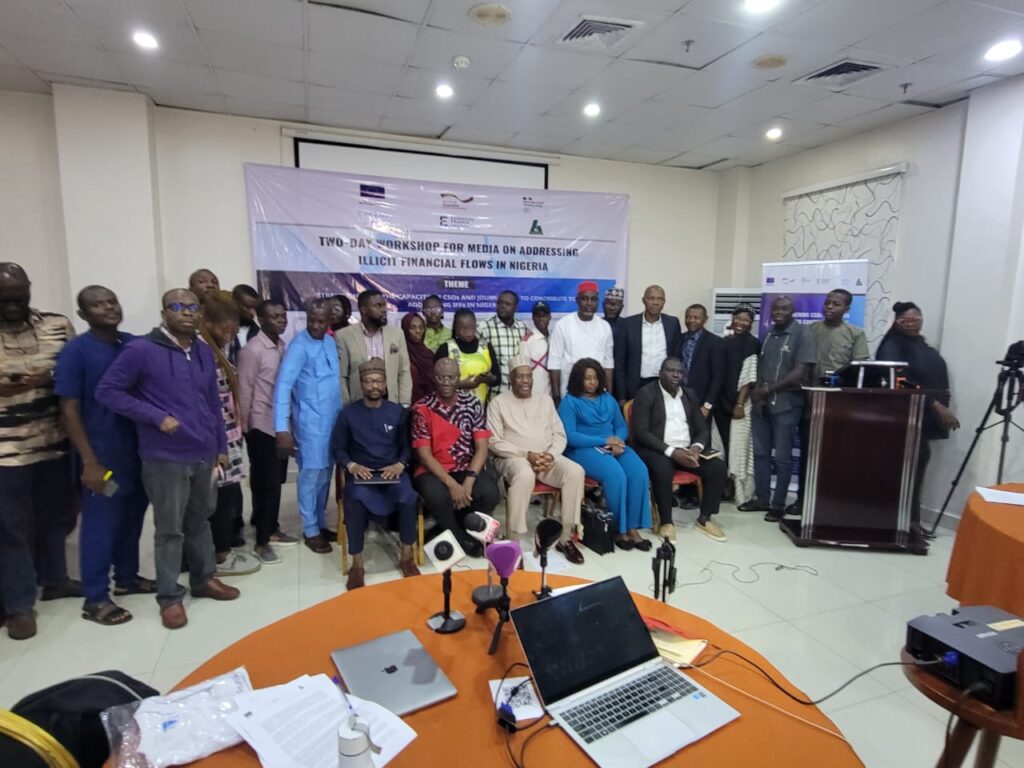
Civil society activist Yusuf Ishyaku Goje told this reporter that the economic impact of illicit financial flows (IFFs) is direct.
He explains that when money is illicitly removed, Nigeria’s tax base shrinks. With a tax-to-GDP ratio of about 10%, far below global benchmarks, the Federal Inland Revenue Service estimates that evasion costs the country trillions of naira in lost revenue each year.
“That shortfall widens budget deficits, increases borrowing, and leaves less for roads, power, hospitals, and schools. Large, undocumented outflows also pressure foreign exchange markets, widen the gap between official and parallel markets, weaken the naira, and raise import and food costs,” he said.
A security expert based in Kano, Dr. Yahuza Getso, clearly links IFFs to insecurity.
He believes that proceeds from banditry, kidnapping, illegal mining, and drug trafficking are moved across borders through trade fraud and informal networks. These funds purchase arms and sustain criminal activities. Simultaneously, reduced revenue limits investment in security equipment and community development, where recruitment happens.
A senior official from the Nigerian Financial Intelligence Unit, who requested anonymity, said agencies are now tracing flows tied to banditry and kidnapping. “When you block the money, you weaken the network. But it requires international cooperation because most funds end up in jurisdictions with weak controls,” the official explained.
The scale is substantial. The African Union–UNECA Thabo Mbeki High-Level Panel Report found that approximately 30.5% of Africa’s illicit outflows from 1970 to 2008 originated from Nigeria, totaling about $217.7 billion. Data from Global Financial Integrity estimates Nigeria’s average annual outflows at around $17.8 billion between 2004 and 2013. More recent estimates indicate annual losses of $15-18 billion, driven by trade misinvoicing, profit shifting by multinationals, aggressive tax avoidance, illegal mining, corruption, drugs, and human trafficking.
Aliyu M. Yusuf Esq., former Director of Proceeds of Crime at the EFCC, detailed key pathways including tax evasion, trade mis-invoicing, extractive-sector leakages, procurement fraud, and settlements that exclude victim countries. He cited the Prime Plastichem case, where a tribunal upheld an additional ₦1.7 billion payment for transfer-pricing manipulation, and the Glencore settlement, in which the company did not receive a direct payout despite allegations of bribery involving NNPC.
Yusuf also spoke on procurement fraud, including inflated contracts and “ghost projects.” He pointed out cost disparities, such as the Lagos-Calabar Coastal Highway costing about $18.57 million per kilometer, compared to India’s Delhi-Mumbai Expressway at roughly $9.38 million per kilometer, despite having more lanes.
In the oil sector, he highlighted illegal bunkering, pipeline vandalism, undeclared exports, and fuel subsidy fraud involving fake import claims and over-invoicing.
Notable cases underscore this pattern. The OPL 245/Malabu scandal, the P&ID arbitration dispute, and the UK conviction of former Delta Governor James Ibori demonstrate how public contracts, offshore secrecy, and cross-border transfers facilitate IFFs.
The US recovery of over $52 million linked to associates of Alison-Madueke, along with her UK acquittal on bribery charges in June 2026, also underscores the complexity of tracing, seizing, and repatriating proceeds of crime.
Civil society leaders say the damage extends beyond stolen cash. Dr. Auwal Musa Rafsanjani, Executive Director of CISLAC, described IFFs as “stolen futures.” “Every dollar that leaves illegally is a school not built, a clinic not equipped, and a job not created. When the state is absent, criminal groups fill the gap,” he said.
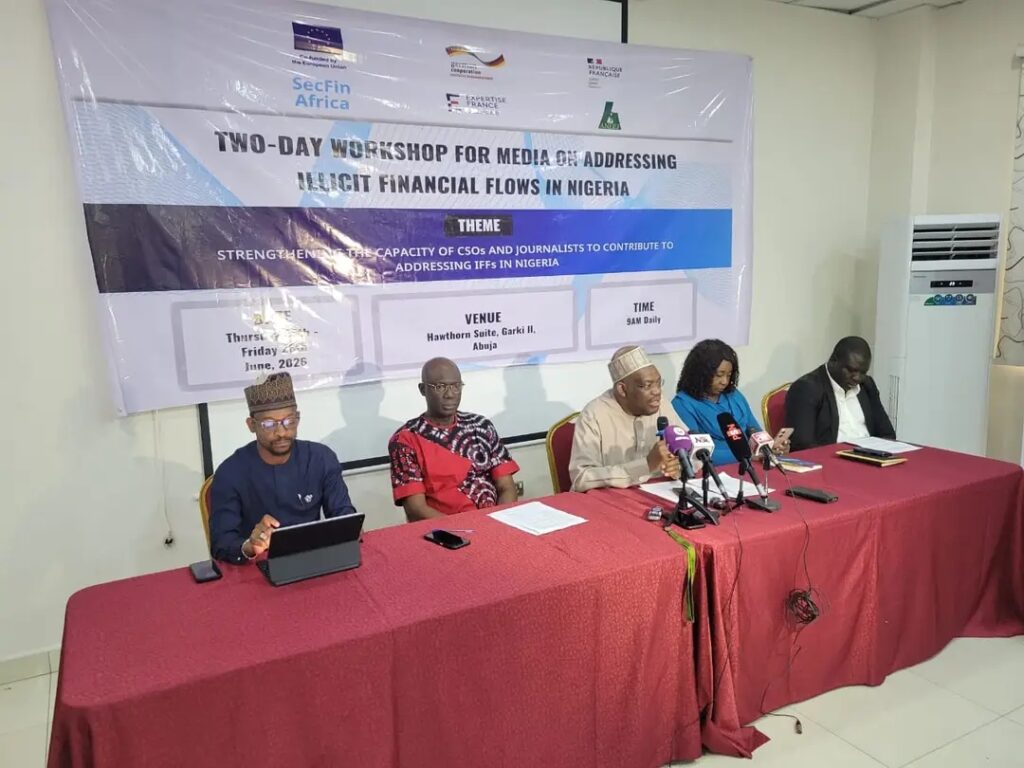
The Deputy Executive Director of the Africa Network for Environment and Economic Justice, ANEEJ, Mr. Leo Atakpu, recently noted that IFFs remain one of the biggest threats to Nigeria’s development.
He explained that these practices deprive the country of resources meant for building schools, upgrading hospitals, creating jobs, and bolstering security. With Nigeria’s tax-to-GDP ratio at about 10% and annual IFF losses estimated between $15 billion and $18 billion, he argued that agencies such as the EFCC, ICPC, NFIU, Nigeria Revenue Service, and Customs need to be supported with strong public oversight, responsible journalism, and evidence-based reporting.
Atakpu emphasized that financial crimes are often complex and intentionally concealed, placing a duty on journalists to verify claims, protect sources, understand legal risks, and clearly differentiate between allegations, investigations, prosecutions, and convictions.
A 2026 assessment by ANEEJ, supported by the European Union through SecFin Africa, describes Nigeria’s framework as “high-form, low-function.”
Laws include the Money Laundering Act 2022, POCA 2022, and the FOI Act, along with institutions such as the EFCC, NFIU, and the Nigeria Revenue Service.
However, fragmentation, weak data interoperability, limited access to accountability tools, and political economy constraints hinder results.
Analysts say the response must include an integrated enforcement architecture with shared intelligence, stronger investigative and judicial capacity, interoperable real-time data systems, enforcement of FOI compliance, and reforms that address incentives and independence.
The new 15% minimum tax for multinationals, digital tax administration, and the Nigeria Revenue Service present opportunities, but their impact will depend on proper implementation.
Experts agree that IFFs are not victimless crimes. They reduce revenue, weaken the currency, limit job creation, and support groups that threaten peace.
Until these flows are tracked, recovered, and deterred, Nigeria will continue facing insecurity and underdevelopment with limited resources. As Rafsanjani said, “You cannot build a secure country on a leaking treasury.”


