

By Femi Oyelola in Kaduna
The Federal Government has announced a new reform plan to ensure that Nigerian children return to school and gain literacy, numeracy, vocational, and digital skills, with a focus on Almajiri and out-of-school children.
The reforms were unveiled in Kaduna by Dr. Balarabe Shehu Kakale, Special Adviser to the Minister of Education on Almajiri and Out-of-School Children, during the National Education Sector Renewal Initiative (NESRI), stakeholder engagement and advocacy event.
He explained that these policies are built around five main pillars: foundational literacy, numeracy, vocational and technical education, digital education, and civic education.
Kakale said the proper implementation of state policies would ensure that no Nigerian child was left without access to education.
He emphasized that the reforms aim to enhance coordination between Federal
state education agencies.
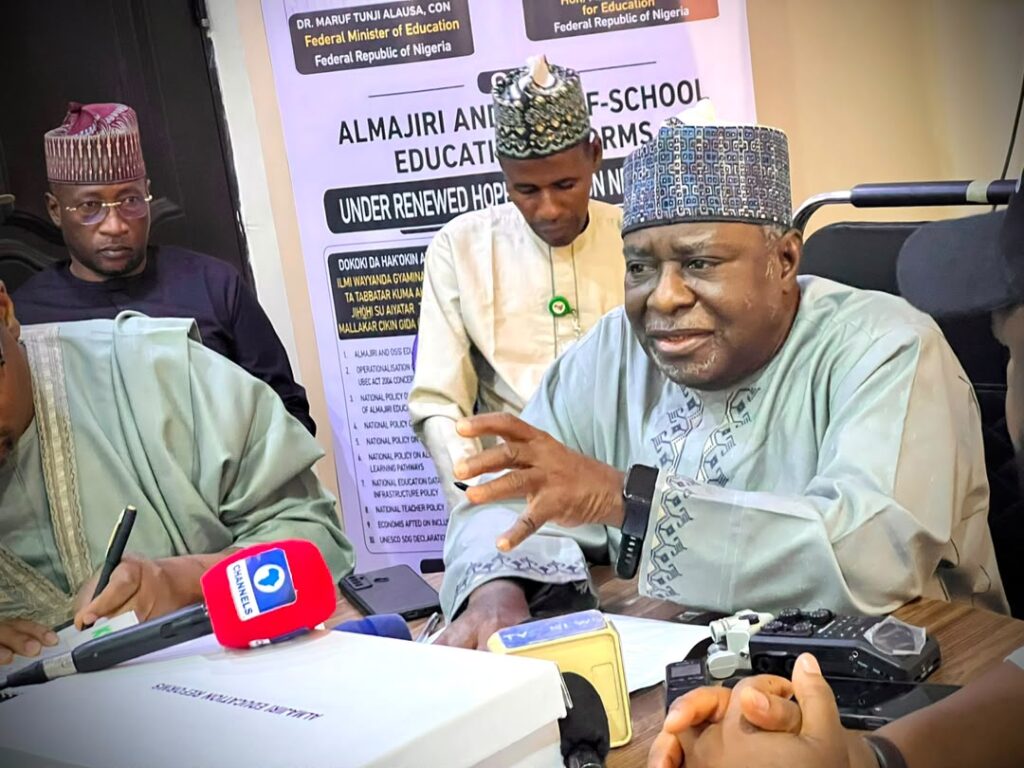
He called on states to adopt and implement the National Commission for Almajiri and Out-of-School Children Education Act, along with policies on Almajiri education, non-state schools, alternative pathways, and the Accelerated Basic Education Program. “Proper implementation by states will ensure that no Nigerian child is left without access to education,” he said.
He praised Kaduna State’s Reaching Out-of-School Children (ROOSC) project as a model for national expansion.
Kakale also highlighted the Federal Government’s efforts to promote data sovereignty through the Nigerian Education Data Infrastructure and other digital management systems. He noted that Nigeria currently lacks a definitive figure for out-of-school children and stressed the importance of accurate data to resolve the challenge.
“We will no longer depend on third-party estimates. We will track children from enrollment through retention and academic progress so that every child, school, teacher, and infrastructure gap is properly captured,” he said. He urged North-West states to adopt federal policies and digital initiatives to boost efforts to bring children back to school.
Representing the Executive Secretary of the National Commission for Almajiri and Out-of-School Children Education, Malam Halliru Musa Halliru expressed the commission’s commitment to transforming Almajiri education through a 10-year strategic plan for 2025–2035.
He stated that the National Policy on the Enhancement of Almajiri Education seeks to strengthen traditional education with literacy, numeracy, and vocational training while maintaining its religious and cultural values. About 200 Almajiri learners at Kaduna’s Tinubu Legacy Skills Training Institute have received training in Arabic, English, and vocational skills and performed well in exams conducted by the National Board for Arabic and Islamic Studies.
Halliru added that 119 learning centers have been established nationwide, and over 700,000 out-of-school children have been identified for targeted interventions. The commission is also gathering comprehensive data on Tsangaya centers and has set up offices in all states and the FCT to improve monitoring.

Kaduna State’s Commissioner for Education, Prof. Abubakar Sani Sambo, emphasized that addressing these challenges requires coordinated efforts among governments and stakeholders.
He identified poverty as a major contributor to school dropout, especially in rural and peri-urban areas, noting that some parents send very young children to Almajiri institutions, which has become a significant issue in the North.
“Accurate data is critical to planning. Kaduna State has fully embraced the Federal Government’s policies and remains committed to addressing the out-of-school challenge,” he said.
Mr. Ezra Angai, the coordinator of Kaduna’s ROOSC project, said the state is adopting a comprehensive approach to restore children to learning. He noted the project aims to reach 100,000 children and has already mapped 187,912 out-of-school children across 23 LGAs.
Angai revealed that over 25,000 children have been returned to school. The project has established Accelerated Basic Education Centers and interventions in Tsangaya schools, signed MoUs with 25 Tsangayas reaching 6,326 learners, and plans to involve 50 more.
He added that 272 schools are planned, including 102 new ones. Infrastructure improvements will support six Tsangayas in the first phase and 27 in the second. Over 40,000 teaching and learning materials, along with uniforms and psychosocial support, have been distributed, and more than 2,000 children with disabilities have received assistive devices in nine LGAs.
The project is supported by organizations such as the Islamic Development Bank, Kuwait Fund for Arab Economic Development, Global Partnership for Education, Education Above All, Save the Children International, and UNICEF.
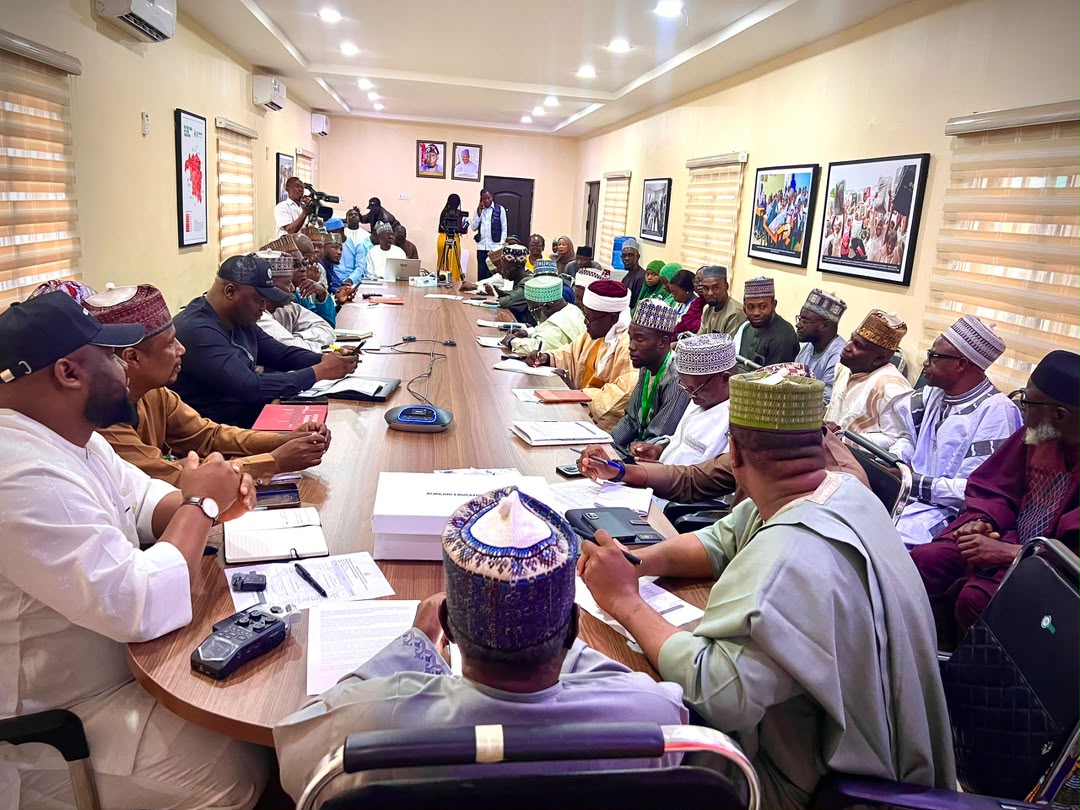
The event brought together government officials, traditional rulers, Islamic scholars, Alarammas, Tsangaya owners, CSOs, and development partners. Participants called for stronger collaboration, better data collection, and community mobilization, pledging support for reforms that integrate Almajiri education with broader learning opportunities and improve access, retention, and outcomes.


